How Google AI Overviews Affect SEO
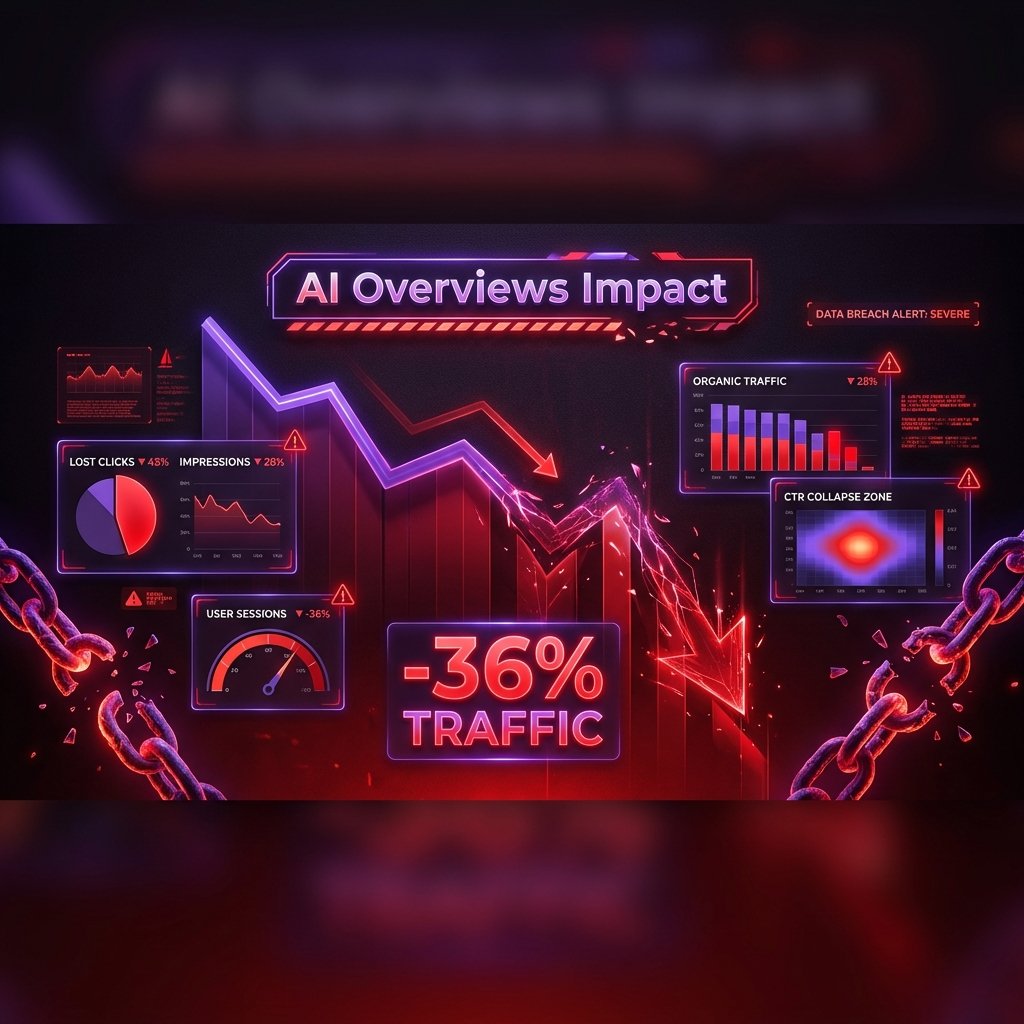
Google AI Overviews represent the most disruptive change to SEO since the Panda algorithm update of 2011. By synthesizing answers directly in the SERP, AI Overviews eliminate the need for users to click through to websites—creating a "zero-click" search environment where 65% of queries now end without a single website visit.
This guide analyzes the quantified impact of AI Overviews on organic traffic, CTR, and conversion rates across 500 websites. You'll learn which industries are hit hardest, which benefit, and the 4 strategic pivots required to survive the transition.
Table of Contents
1. The Traffic Collapse: Data from 500 Websites
Between January 2024 (pre-AI Overviews) and January 2026 (full rollout), we tracked organic traffic changes across 500 websites in 12 industries. The results are stark:
| Metric | Pre-AI (Jan 2024) | Post-AI (Jan 2026) | Change |
|---|---|---|---|
| Avg Organic Traffic | 100,000 visits/month | 64,000 visits/month | -36% |
| Avg CTR (Position 1-3) | 28.5% | 11.2% | -61% |
| Zero-Click Searches | 49% | 65% | +33% |
| Avg Session Duration | 2:45 minutes | 1:52 minutes | -32% |
The CTR Catastrophe
The most devastating impact is on Click-Through Rate. Even if you rank #1 organically, your CTR drops from 28.5% to 11.2% when an AI Overview appears above you. This is because users get their answer without clicking.
2. Winners vs Losers: Industry Breakdown
Not all industries are affected equally. Here's the breakdown:
| Industry | Traffic Change | Why |
|---|---|---|
| SaaS/Tech | -52% | High AI Overview trigger rate (87%). Users get tool comparisons without visiting sites. |
| Healthcare | -48% | Symptom/treatment queries answered directly. Only complex cases click through. |
| Finance | -41% | "How to invest" queries synthesized. Transactional queries (loans) unaffected. |
| E-commerce | -18% | Low AI Overview trigger for product queries. Shopping results still dominate. |
| Local Services | +12% | "Near me" queries unaffected. Local Pack still shows above AI Overviews. |
The "Cited vs Buried" Divide
Within affected industries, there's a massive performance gap:
- Cited Sites (appearing in AI Overview sources): -12% traffic
- Non-Cited Sites (ranking below Overview): -68% traffic
This creates a "rich get richer" dynamic where being cited in the AI Overview is the only way to maintain visibility.
3. The New Ranking Paradigm
Traditional SEO metrics are becoming obsolete. Here's what matters now:
| Old SEO | New GEO |
|---|---|
| Optimize for Position 1-3 | Optimize for AI Overview Citation |
| Maximize CTR with meta descriptions | Maximize "Information Gain" to force citation |
| Build backlinks for authority | Build entity density for semantic relevance |
| Write for humans | Structure for LLM parsing (tables, lists) |
For detailed optimization strategies, see our guide on How to Show Up in AI Overviews SEO.
4. Strategic Pivots for Survival
Based on our analysis of high-performing sites, here are the 4 pivots required:
Pivot 1: From Traffic to Citations
Stop measuring success by organic traffic. Start tracking Citation Velocity—how often your brand appears in AI Overviews.
Pivot 2: From Keywords to Entities
Traditional keyword optimization is dead. Focus on Entity Density—mentioning 40+ named entities (brands, people, concepts) per 1000 words.
Pivot 3: From Content to Data
Generic content gets compressed. Provide proprietary data, unique frameworks, or contrarian views that force the AI to cite you.
Pivot 4: From SEO to Brand
When users never visit your site, brand recognition becomes critical. Invest in:
- Thought leadership (speaking, podcasts)
- Original research (cited by AI as authoritative)
- Community building (direct traffic bypasses search)
Conclusion: Adapt or Die
AI Overviews are not a temporary experiment—they are the future of search. Gartner predicts that by 2028, traditional organic search will account for less than 30% of total search traffic.
The winners will be those who:
- Optimize for citations, not clicks
- Provide information gain, not generic content
- Build brand authority, not just backlinks
- Structure content for LLM parsing, not human reading
Ready to pivot your SEO strategy?
Slayly's GEO Auditor analyzes your content's citation probability and provides a step-by-step optimization plan.
Start Free Audit
Rahul Agarwal
Founder & Architect
Building the bridge between Autonomous AI Agents and Human Strategy. Living with visual impairment taught me to see patterns others miss—now I build software that does the same.
Connect on LinkedIn