Is AI Search Optimization Different from SEO? 12 Key Differences
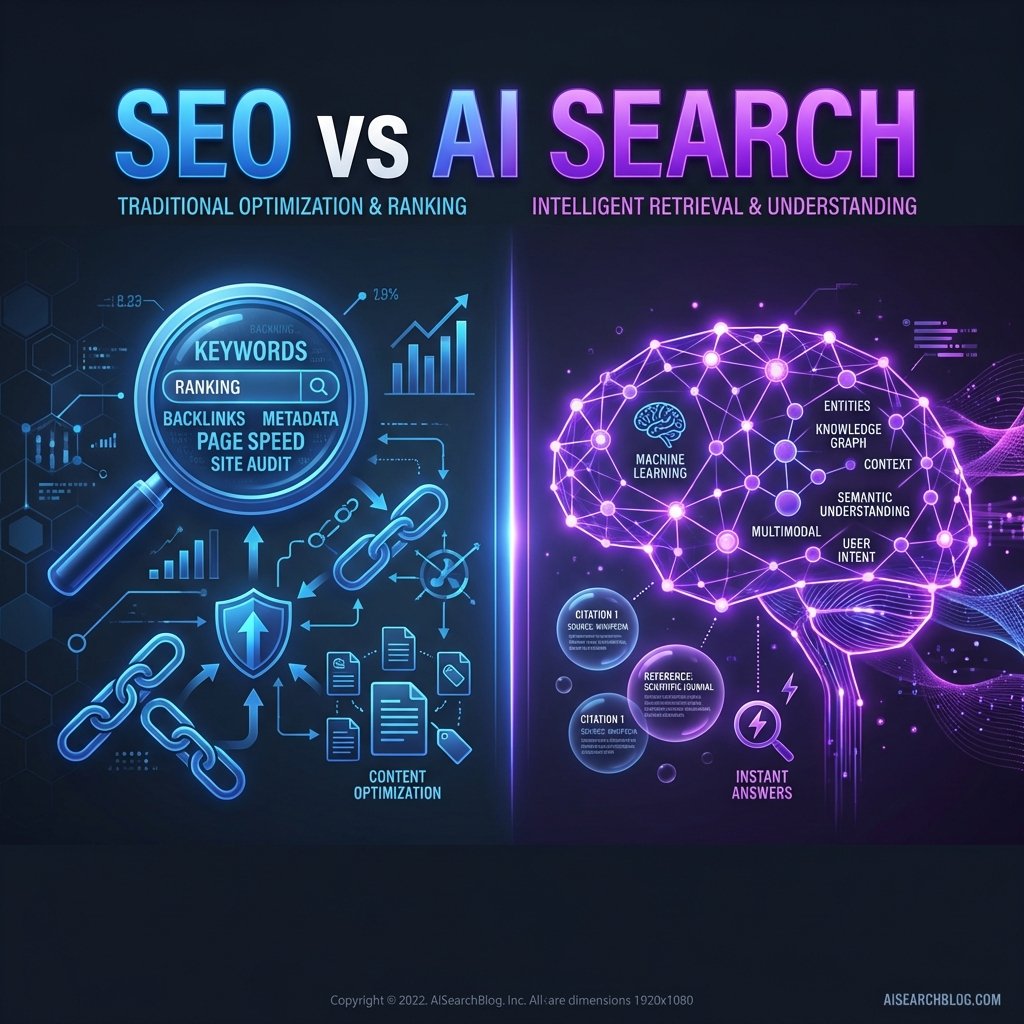
AI search optimization and traditional SEO share the same goal—visibility in search results—but the tactics, metrics, and success criteria are fundamentally different. While SEO optimizes for clicks, AI search optimization (also called GEO - Generative Engine Optimization) optimizes for citations.
This guide breaks down the 12 key differences between SEO and AI search optimization, from technical implementation to content strategy. You'll learn when to use each approach and how to build a hybrid strategy that dominates both paradigms.
Table of Contents
1. The Core Difference: Retrieval vs Synthesis
The fundamental distinction:
- Traditional SEO: Optimizes for retrieval—matching keywords to documents and ranking them by relevance.
- AI Search (GEO): Optimizes for synthesis—providing information that an LLM can combine with other sources to generate a new answer.
The Paradigm Shift
In SEO, you want users to click your link. In GEO, you want the AI to speak your name when answering the query—even if the user never visits your site.
2. 12 Key Differences: SEO vs AI Search
| Dimension | Traditional SEO | AI Search (GEO) |
|---|---|---|
| 1. Success Metric | Click-Through Rate (CTR) | Citation Rate |
| 2. Ranking Factor | Backlinks + Domain Authority | Entity Density + Information Gain |
| 3. Content Goal | Match user intent | Provide unique data/perspective |
| 4. Keyword Strategy | Exact match + LSI keywords | Semantic entities + Wikipedia links |
| 5. Schema Markup | Article, Product, FAQ | TechArticle with 'mentions' + 'about' |
| 6. Content Structure | Readable paragraphs | Tables, lists, code blocks (LLM-parseable) |
| 7. Title Optimization | Clickbait + emotional triggers | Direct answer + keyword |
| 8. Meta Description | Persuasive CTA | Factual summary (LLM reads this) |
| 9. Image Optimization | Alt text for accessibility | Alt text as semantic signal |
| 10. Internal Linking | Distribute PageRank | Build topic clusters |
| 11. Update Frequency | Quarterly | Monthly (freshness signal) |
| 12. Traffic Source | Organic clicks | Brand recognition → Direct traffic |
Deep Dive: Entity Density vs Keyword Density
The shift from keywords to entities is the most profound change:
SEO Approach (Keyword Density):
"The best SEO tools include SEO software like SEO platforms..."
→ Keyword stuffing, low semantic value

GEO Approach (Entity Density):
"The best SEO tools include Semrush, Ahrefs, Moz, and Screaming Frog..."
→ Named entities, high semantic value
Why Entities Matter: LLMs understand the world through entities (people, places, brands, concepts). Mentioning "Semrush" creates a semantic link to "SEO tools" in the knowledge graph. Repeating "SEO tools" does not.
3. When to Use Each Strategy
Not all content should be optimized for AI search. Use this decision tree:
| Content Type | Optimize For | Reason |
|---|---|---|
| Informational Guides | GEO (AI Search) | High AI Overview trigger rate (94%) |
| Product Pages | Traditional SEO | Transactional queries don't trigger Overviews |
| Comparison Posts | GEO (AI Search) | "X vs Y" queries have 98% Overview trigger |
| Local Service Pages | Traditional SEO | "Near me" queries show Local Pack, not Overviews |
| Thought Leadership | GEO (AI Search) | Citations build brand authority |
For more on query-specific optimization, see our guide on What Triggers an AI Overview SEO.
4. Building a Hybrid Optimization Strategy
The most effective approach combines both SEO and GEO:
The 70/30 Rule
- 70% of content: Optimize for GEO (informational, comparison, how-to)
- 30% of content: Optimize for traditional SEO (transactional, local, product)
Implementation Checklist
Hybrid Optimization Checklist
- Audit content: Categorize by query type (informational vs transactional)
- GEO content: Add entity density, tables, TechArticle schema
- SEO content: Optimize meta descriptions, build backlinks
- Track both metrics: CTR (SEO) + Citation Rate (GEO)
- Update monthly: Refresh GEO content to maintain freshness signal
Conclusion: Two Games, One Strategy
AI search and traditional SEO are not mutually exclusive—they're complementary. The best strategy is to:
- Identify which queries trigger AI Overviews
- Optimize informational content for GEO (citations)
- Optimize transactional content for SEO (clicks)
- Track both CTR and Citation Rate
The future belongs to those who master both paradigms.
Master both SEO and GEO
Slayly's Hybrid Optimizer automatically detects query types and applies the right strategy.
Start Free Trial
Rahul Agarwal
Founder & Architect
Building the bridge between Autonomous AI Agents and Human Strategy. Living with visual impairment taught me to see patterns others miss—now I build software that does the same.
Connect on LinkedIn